Eusung Lee:
in the air
20 August 2026 - 27 September 2026
YPC SPACE, Seoul
27 August 2026 - 17 October 2026
xlage
Curated and organized by Jiwon Yu (YPC SPACE) and Jaeseok Kim (xlarge)
Assistance from Kwak Eunseon, Yoon Jangmi, Jane Lee (production), So Minkyoung, Song Minjung (collaboration)
Design by Joel Lee
Supported by Seoul Foundation for Arts and Culture and Seoul Metropolitan Government
Special thanks to Kang Soyoung, Lee Seoyeon, and Lee Heewon
집을 나설 때 일기예보를 살핀다. 최고 기온 30, 최저 기온 23, 강수 확률은 45%. 이 숫자가 무얼 의미하는지 엄밀히 이해하지는 못한다. 어제보다는 시원하겠다 싶은 어렴풋한 느낌, 날이 흐릴 수는 있겠으나 굳이 우산은 챙기지 말아야겠다는 희미한 판단으로 그날을 감당할 마음을 먹는다. 때로는 감당하기 어려운 방대한 세상에 던져진 우리는 각종 개념적 장치를 일기예보마냥 이용한다. 속도, 자아, 기억, 친밀감 같은 추상적 개념의 뜻을 적당히 아는 셈치고 그것을 이용해 우리가 내던져진 환경을 가늠하고, 타인과 소통하며, 변수를 통제한다. 하지만 이내 어깨가 축축하게 젖어오고, 비가 오고야 말았다는 것을 알아채고 걸음을 재촉한다. 사회적 관념은 몸을 통과하며 비로소 리얼리티가 된다. 그날의 공기가 감지된다. 그리고 그에 맞추어 몸은 재정렬된다.
몸을 닮은 상은 피부의 감각과 근골격계의 배치, 습관적인 자세로 시뮬레이션을 거듭한 추상적인 개념이 똬리를 트는 곳이다. 이유성이 2023년부터 천착한 인체 조각은 살아 숨 쉬는 사람을 캐스팅한 조각으로, 창작자의 관점으로 인간상을 재구성하기보다 특정 개체를 본떠 시대가 몸에 남긴 압력의 형상을 소재로 삼는다. 인체상은 석불을 비롯한 종교적 형상, 각종 실험을 위한 대체제, 탐구를 위한 크로키, 자기애적인 표현 등 유구한 전통과 광범위한 문화를 관통하며 생존했다. 그토록 지속적이고 편재하는 형상이면서도, 인체상은 시시각각 달라지는 시대의 공기를 충실히 담아왔다. 이유성이 선택한 캐스팅 기법은 일종의 용기(容器)로서의 몸을 물리적으로 구현한다. 기계적인 복제에 가까운 본뜨기는 표현, 재현, 나아가 독해 이전의 접촉, 표면, 그리고 공간의 국면으로 옮겨간다. 살아 숨 쉬는 몸에 직접 접촉하여 그 피부에 가까운 것이 되었다가 떨어져 나간 껍데기는 이내 그 자신의 숨이 아닌 점유한 장소의 공기를 담는 공간이 된다. 서거나 앉거나 무언가를 타고 있는 형상인 동시에 공간 그 자체인 것. 복제물에 불과한 것을 잘 알면서도 우리의 모습을 닮은 그것은 우리를 대신하여 공간으로 존재하는 법을 실험하는 듯하다.
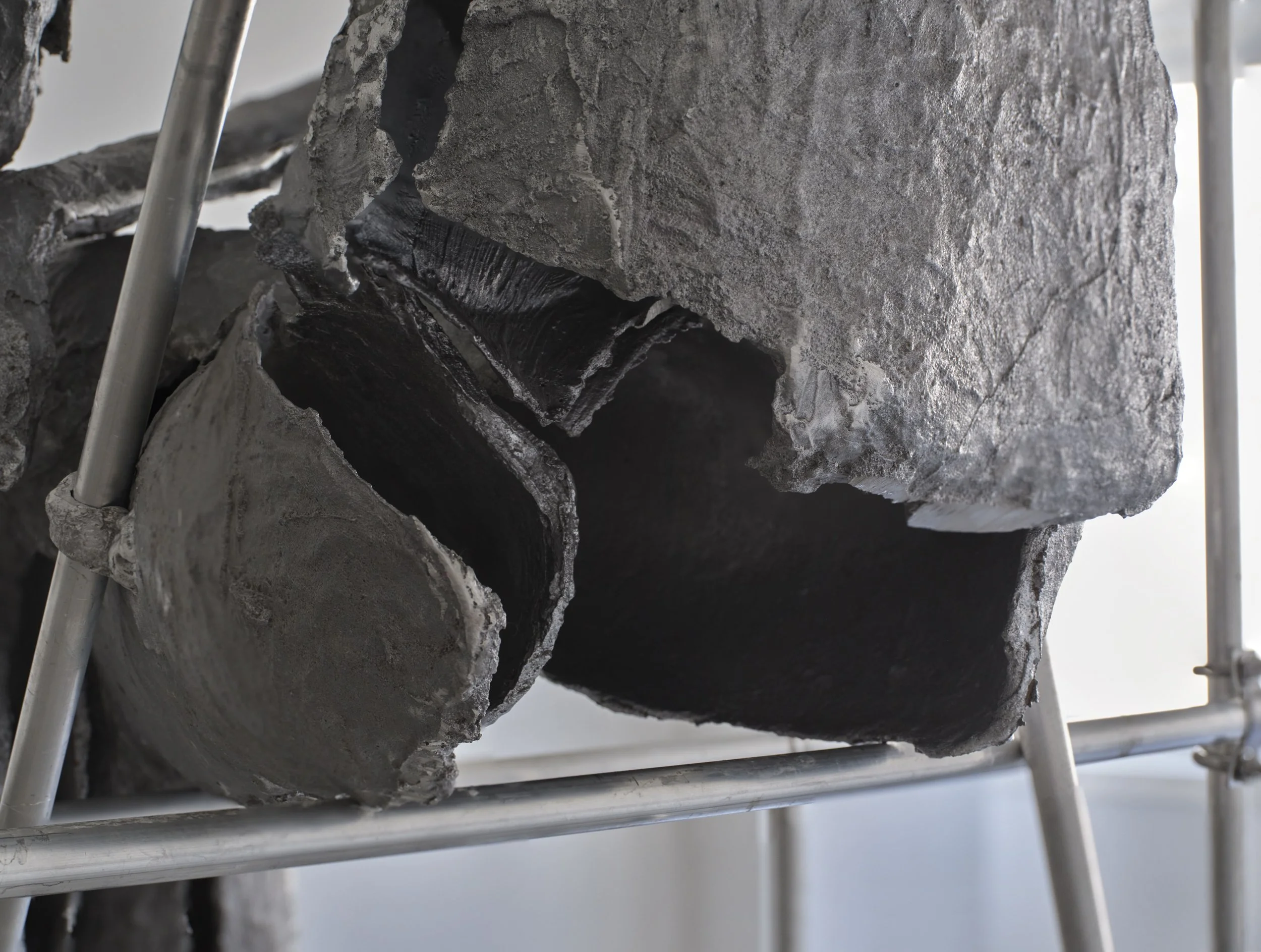
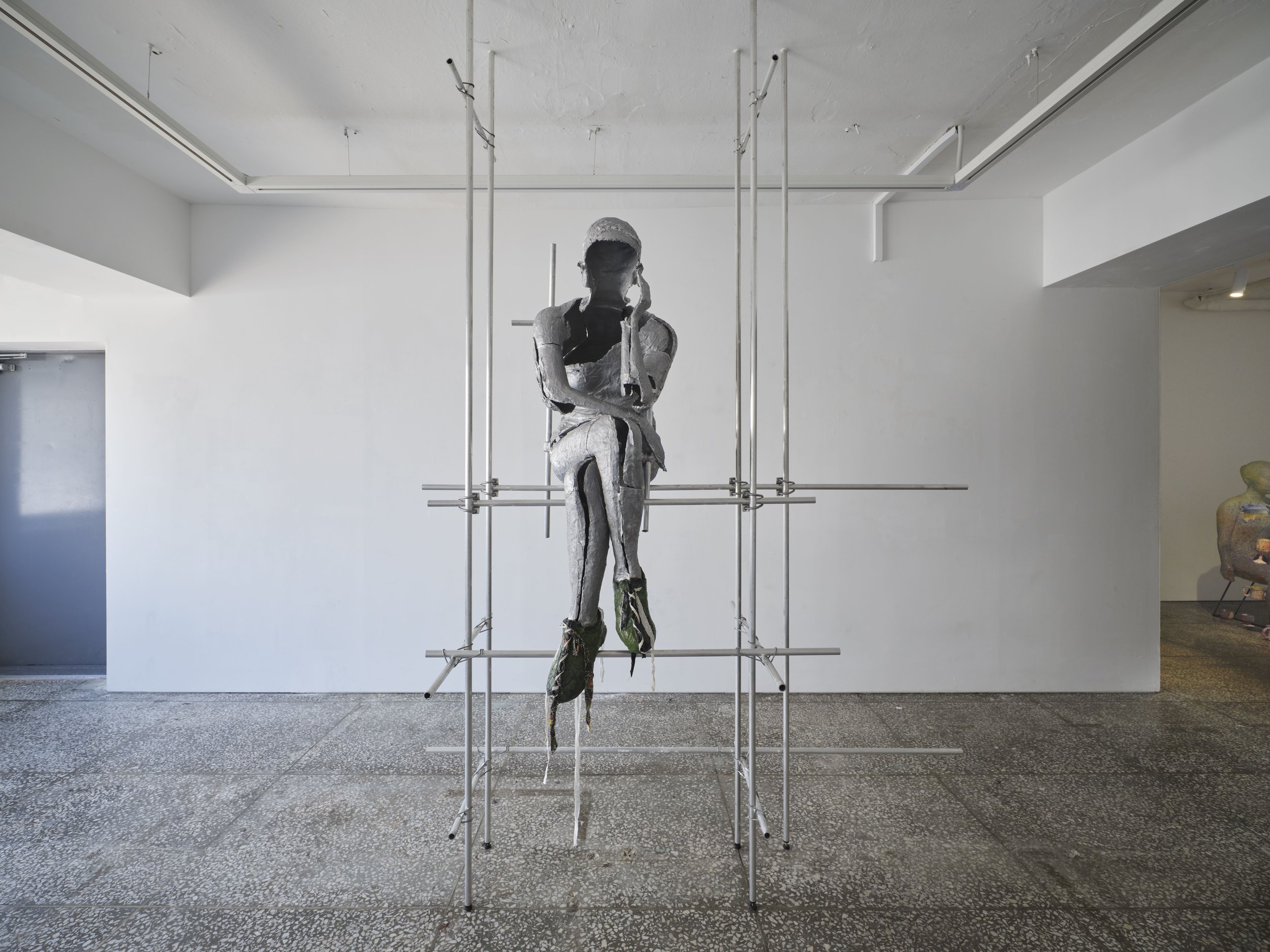
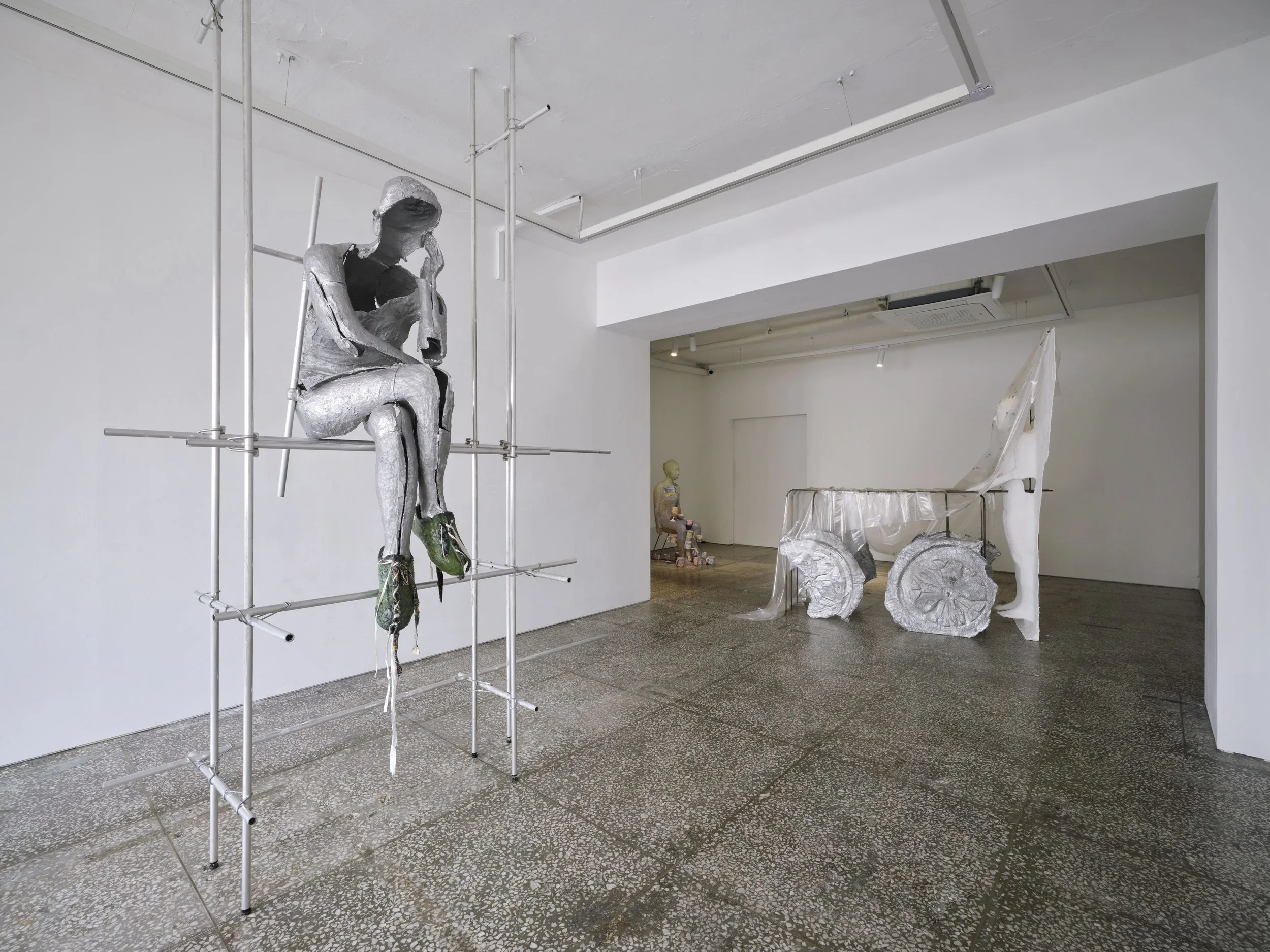
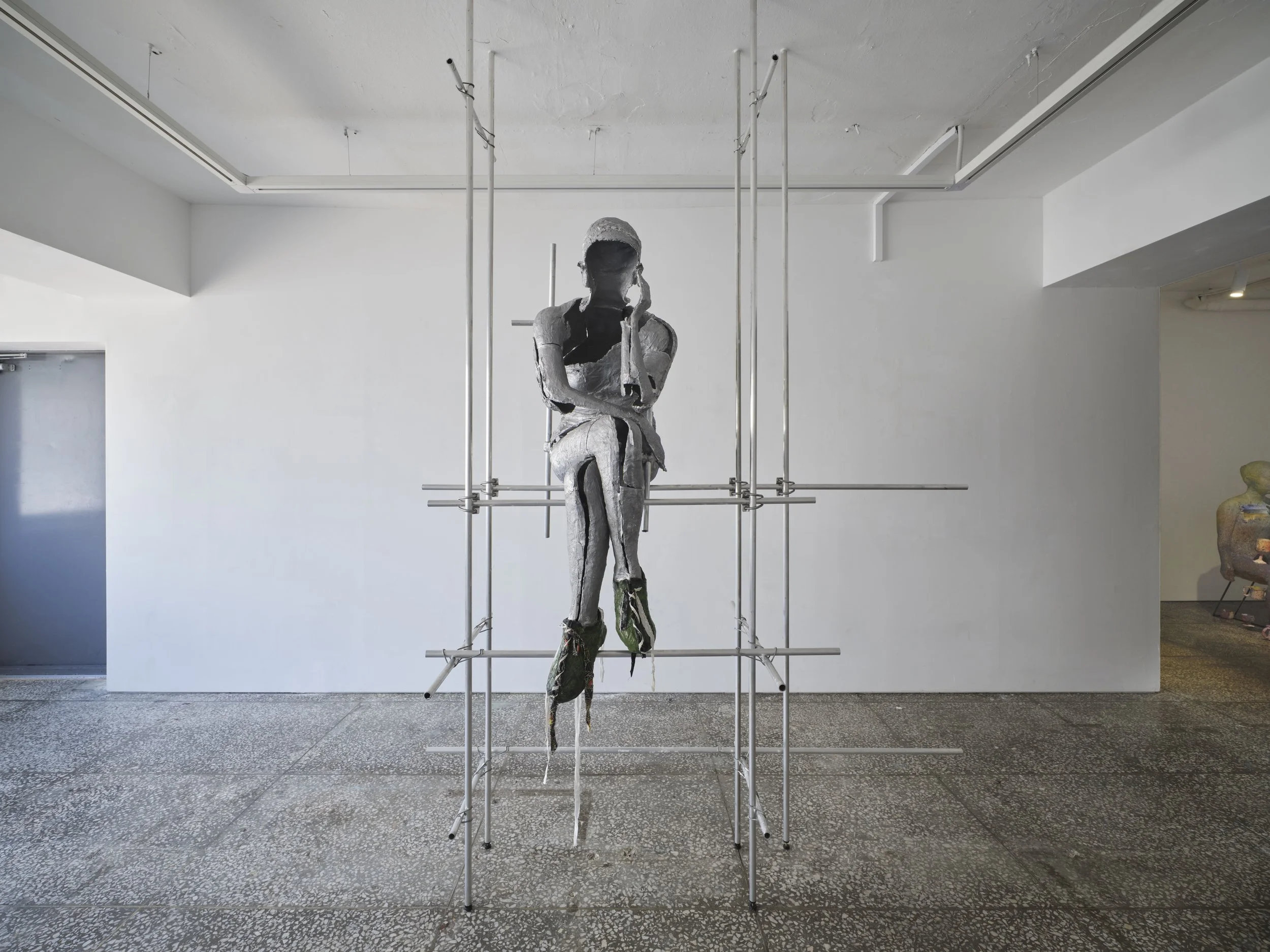
물론, 그 대리자는 온전치 않다. 이유성의 조각은 접합부가 노출되어 비어 있다는 사실을 감추지 않고, 이질적인 사물과 결탁한다. 작가가 직접 자신의 몸을 부분부분 캐스팅한 알루미늄 조각 〈라디오 우먼(reconstruction)〉(2026)은 어떤 존재가 깨고 나온 알의 조각을 힘겹게 다시 맞춘 모양새로 비계 구조물에 걸터앉아 있다. 알루미늄보다 3배쯤 무거운 브론즈로 캐스팅한 운동화를 신은 이 우먼은 아무래도 걷지 못할 것이고, 그 운명을 알고 있는 듯 생각에 잠겨 있다.
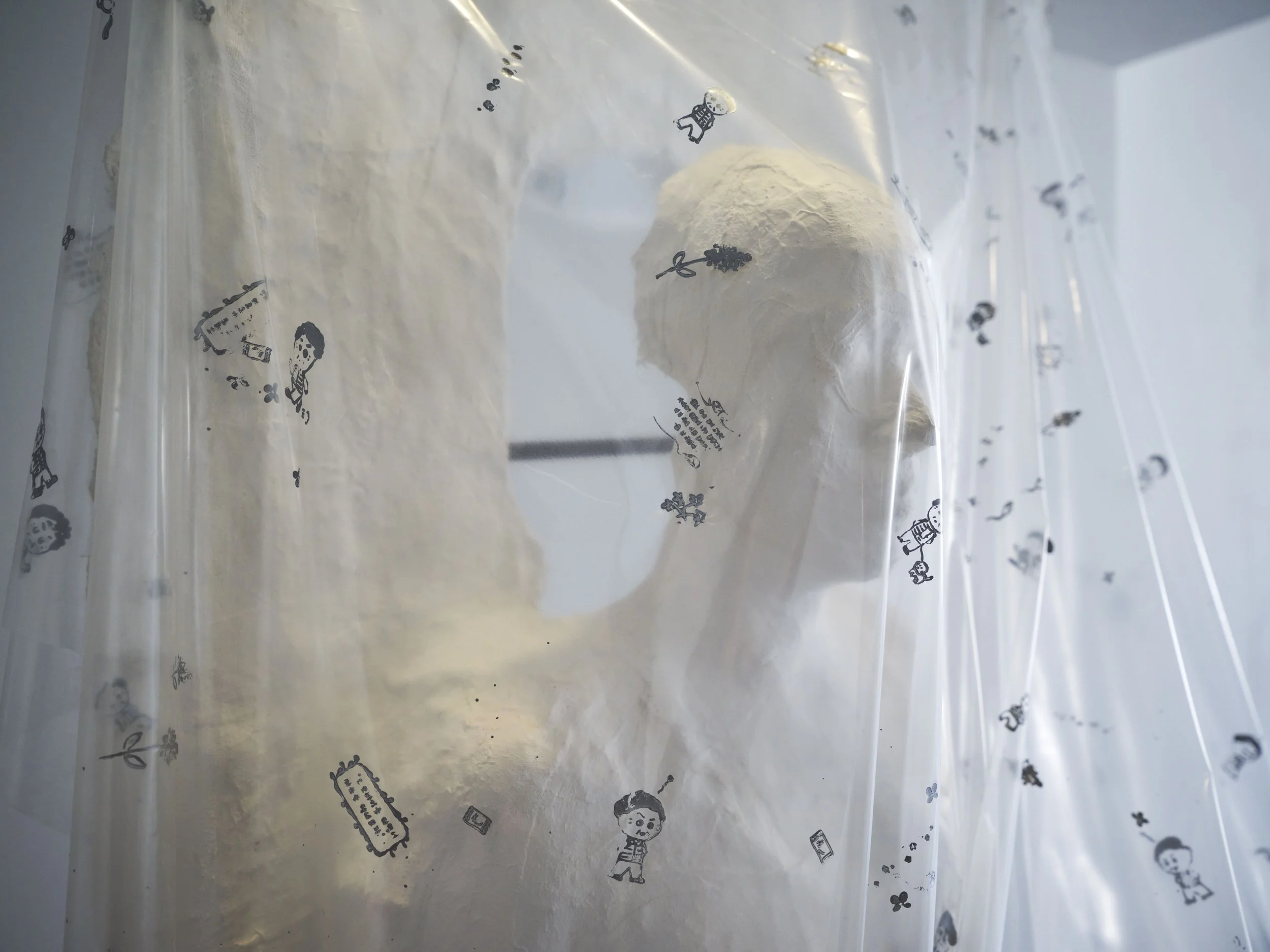
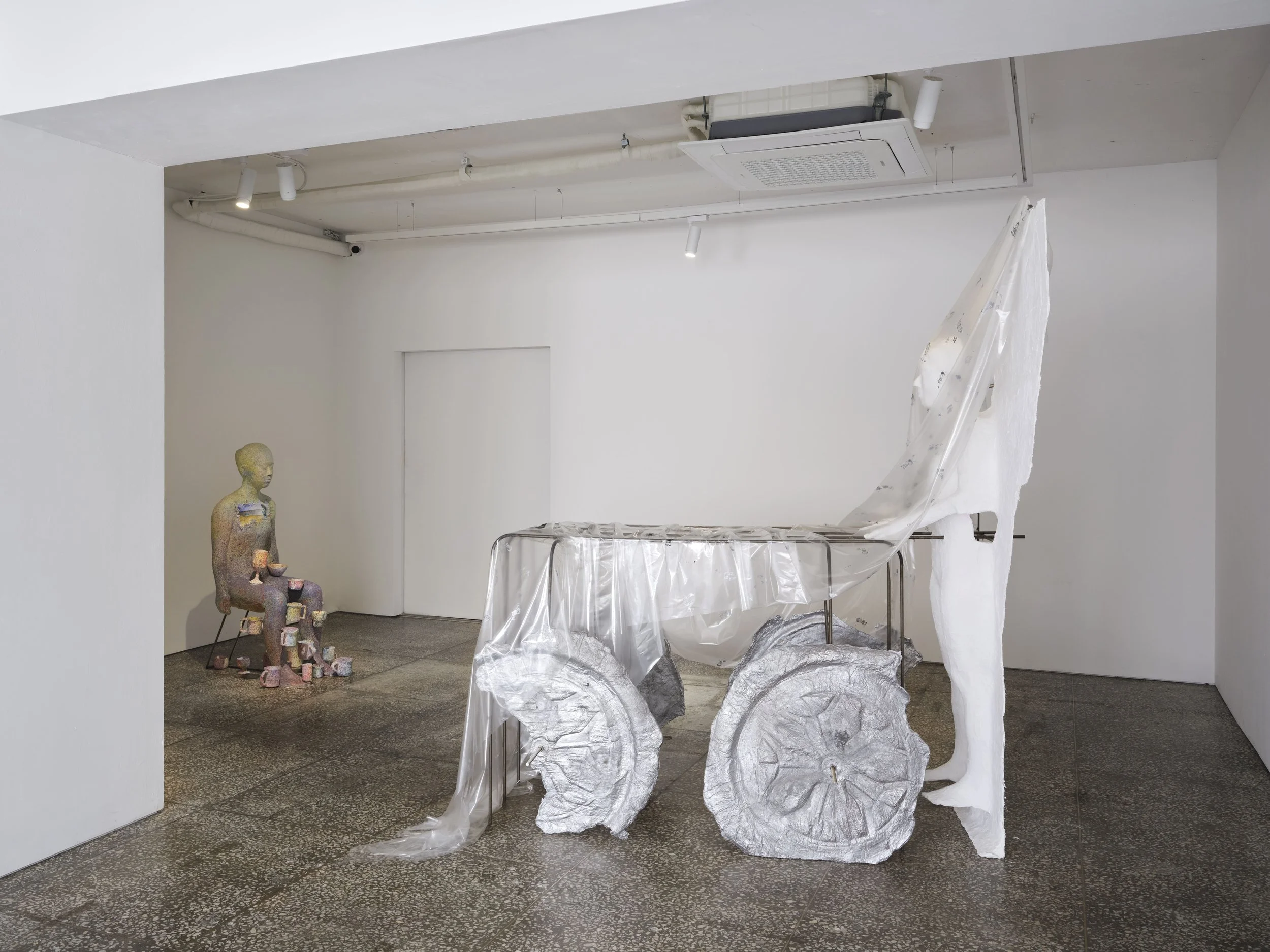
‘야쿠르트 아줌마’ 혹은 정식 명칭으로 ‘프레시 매니저’가 이동형 냉장 카트에 올라타 이동하는 모습의 〈비닐봉지 스핑크스〉(2026)는 보다 가벼운 한편 아리송하다. 석고붕대로 본뜬 몸체, 앙상한 뼈대로만 구현된 탈것, 이전 작업에서 작가 자신의 자가용을 종이죽으로 덮었다 떼어낸 껍질을 캐스팅한 바퀴, 동료 작가 송민정과 협업하여 만든 문양을 스티커처럼 찍어 넣은 비닐로 이를 덮어 놓은 형세까지. 각 요소가 단어라면 그 조합은 논리적으로 정합적이지 않은 문장일 것이 분명한 이 조각. 그것은 이 모든 것의 조합이 과연 무엇이냐고—스핑크스처럼— 질문하는 동시에, 그 답변이 무엇이든—비닐봉지마냥—투명하고 넉넉하게 담아낸다.
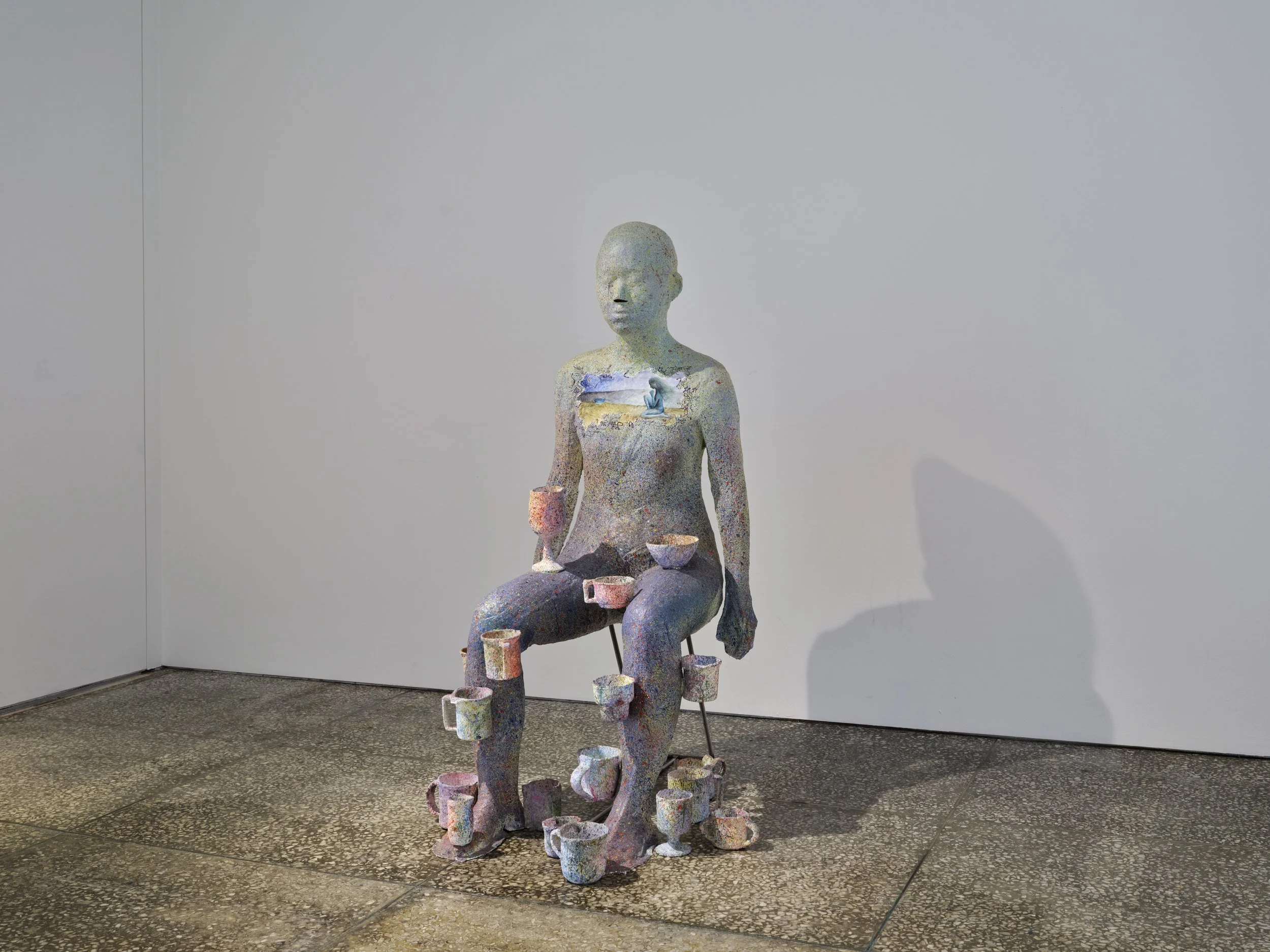
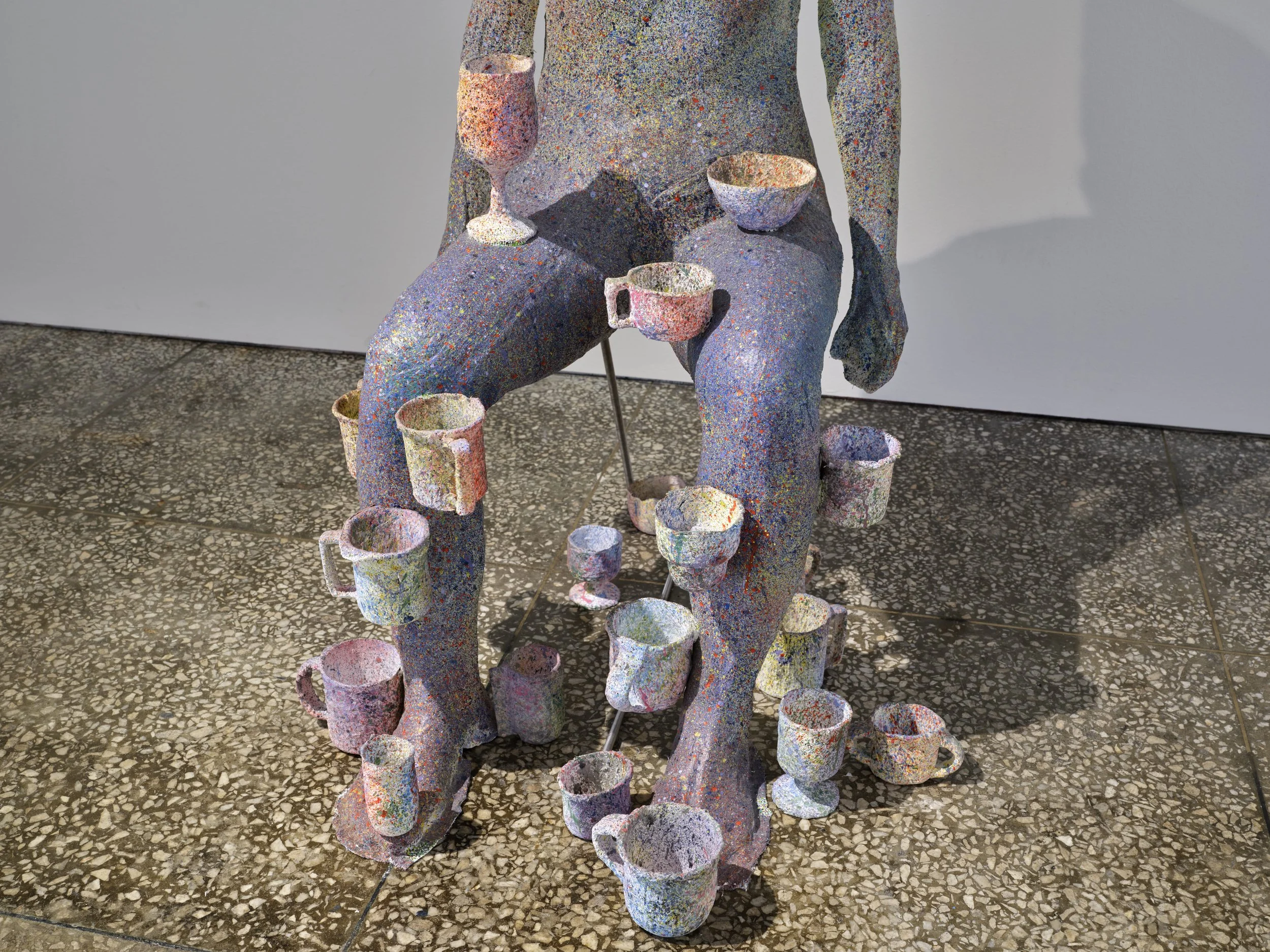
다른 한편, 〈약사여래좌상〉(2026)은 조각의 표면을 마치 백지처럼 그리는 손에 내어준다. 중생의 질병을 고쳐주는 부처 ‘약사여래’에서 출발하되, 치유(힐링)를 둘러싼 현대적 관념과 웰빙을 성취하기 위한 행동 패턴이 일상적인 사물로 집약되어 부착되어 있는 조각. 그것은 오랜 동료이자 작가 소민경이 그림을 그려 넣을 수 있는, 설거지를 제때 하기 어려운 누군가의 작업실마냥 쌓여가는 컵을 짊어질 수 있는 공간적 여유를 자랑한다. 이 버전의 약사여래 또한 치유 능력을 지니고 있다면, 그것은 내재적인 힘이 아니라 다른 사람의 흔적과 생활을 수용하는 상태에서 비롯되는 것일 테다.
이 세 몸-조각이 담지하는, 혹은 그것을 관통하는 이 시대의 대기는 어떠한가? 생명과 존재의 가벼움, 그것이 야기하는 사소한 절망과 당혹스러운 헛웃음, 만들어진 친밀감, 간편한 의미의 재구성, 오랜 동료와 일회적인 협력을 아우르는 사람들의 마주침, 몸과 마음의 안녕을 염원하며 임의로 조직한 습관, 그럼에도 인간–그게 과연 무엇이든–노릇을 하려는 꺾이지 않는 의지. 이유성의 몸들은 파편을 봉합하여 서 있고, 무언가에 걸치거나 올라타고, 다른 물체를 지탱하거나 지탱받으며 임시적으로 구성되고 유지되는 삶, 혹은 공간을 차지하는 존재들의 상태를 펼쳐낸. 그때그때 조립하고 지탱해야 하는 상태는 그러나 거대한 비극으로 처리되지 않고 완전한 독해에 저항하며 약간의 유머까지 구사한다. 그러니 우리는 용기를 낸다. 오늘의 날씨를 묻고, 정확도를 장담할 수 없는 추상적인 언어를 굳이 피하지 않으며, 나를 둘러싼 공기가 초래하는 산뜻함이나 난처함을 당해버리고, 그것을 감당하기 위해 몸을 재정렬하고, 그러면서 속이 빈 조각들처럼, 그저 얼마간의 공간을 차지해본다.
Before leaving the house, I check the weather forecast. High 30°C, low 23°C, 45 percent chance of rain. I cannot claim to know exactly what these numbers mean. They leave me instead with only the faintest sense that the day may be cooler than yesterday, a vague inclination to think that although the sky might cloud over, an umbrella can probably be left behind. With that, I make myself ready to face the day. At times, finding ourselves cast into a world too vast to take in, we rely on conceptual frameworks much as we rely on the weather forecast. We proceed as though we know, more or less, what abstractions such as speed, self, memory, and intimacy mean, using them to gauge the conditions in which we find ourselves, to communicate with others, and to keep contingency at bay. Then our shoulders begin to dampen. It has started raining after all, and we hurry our steps. It is only in passing through the body that social conventions acquire the force of reality. The air of the day is finally felt. The body, in turn, rearranges itself accordingly.
The human figure is a place where abstract concepts, repeatedly simulated through the sensations of the skin, the configuration of the musculoskeletal system, and habitual postures, come to coil themselves. The human figure sculptures that Eusung Lee has explored since 2023 are cast directly from living, breathing people. Rather than reconstructing the figure through the maker’s point of view, Lee takes as her material the forms of pressure that an era leaves upon the bodies. The human figure has survived across a remarkably long history and broad range of cultures: as religious icons including stone Buddhas, substitutes used in experiments, croquis made for study, and vehicles of narcissistic self-expression. Yet for all its persistence and ubiquity, it has also faithfully absorbed the changing air of its time.
The casting technique Lee employs gives physical form to the body as a kind of container. Mold-making, closer to mechanical replication than expressive modeling, shifts the work away from expression, representation, and even interpretation, toward contact, surface, and space. A shell that has come into direct contact with a living, breathing body, becoming for a time something close to its skin before peeling away, soon becomes a space containing not its own breath but the air of the place it occupies. A figure standing, sitting, or riding something, and at the same time a space in itself. Though we know perfectly well that it is only a copy, its resemblance to us makes it seem to experiment on our behalf with how a body might exist as space.
The surrogate, of course, is far from whole. Lee’s sculptures make no attempt to conceal their exposed seams or their hollowness, and readily enter into alliances with heterogeneous objects. Radio Woman (reconstruction) (2026), an aluminum sculpture for which the artist cast her own body in sections, perches on a scaffold-like structure like fragments of an egg that some creature has broken out of and then struggled to piece back together. Wearing sneakers cast in bronze—roughly three times heavier than aluminum—this woman is unlikely to walk out of here. She appears absorbed in thought, as though aware of her fate.
Plastic Bag Sphinx (2026) is modeled on the familiar sight in Korea of a “Yakult lady”—officially called a “Fresh Manager”—riding her motorized refrigerated sales cart. The sculpture brings together a body molded in plaster bandages, a vehicle reduced to a skeletal frame, wheels cast from the shell of an earlier work for which Lee covered her own car in papier-mâché and peeled it away, and a sheet of plastic printed with patterns made in collaboration with a close friend and artist Song Minjung, draped over the structure like a skin. Together, these disparate elements form a kind of broken syntax, refusing to settle into a coherent meaning. Like a sphinx, the sculpture asks what, exactly, this assemblage of things might be; at the same time, like a plastic bag, it remains transparent and capacious enough to hold whatever answer we might give.
Seated Medicine Buddha (2026), meanwhile, begins with the figure of Bhaisajyaguru, the Medicine Buddha traditionally believed to heal the illnesses of sentient beings. Lee recasts this association with healing through contemporary ideas of wellness and everyday routines for achieving it, bringing these together on the sculpture’s surface in the form of familiar objects. It offers enough space for So Minkyung, another long-time friend artist, to draw on its surface, while also bearing the cups that accumulate in a perpetually untidy studio. If this version of the Medicine Buddha possesses any healing power, it comes not from an intrinsic force but from its capacity to accommodate the traces and everyday lives of others.
What, then, is the air of our time that these three body-sculptures hold, or that passes through them? The lightness of life and existence; the small despairs and bewildered laughter it produces; manufactured intimacy; the easy reassembly of meaning; encounters among people from long-standing companionship to one-off collaborations; habits arbitrarily organized in the hope of keeping body and mind well; and, despite it all, an unyielding will to keep on being human—whatever that may mean. Pieced together from fragments, perched on or riding something, bearing other objects or relying on them for support, Lee’s bodies give form to a life held together provisionally, and to the condition of occupying space through continued acts of assembly, balancing, and bracing. Yet this precarity is not cast as grand tragedy. Resisting any complete reading, they even manage a measure of humor.
And so we muster a little courage—and, like vessels, make room. We ask what the weather is today, without shying away from abstract languages whose accuracy can never be guaranteed. We let ourselves encounter the freshness or discomfort brought on by the air around us, rearrange our bodies to bear it, and simply occupy a little space for a while.