CONTRIBUTION
Solitary
Tyler Cobrn ed.
With contributions by Jaeyeon Chung, Tyler Coburn, Sunjin Kim, Hyunjeung Kim, Kyungmook Kim, Min Kyoung Lee, Woochang Lee, Russell Mason, InYoung Yeo, Jiwon Yu
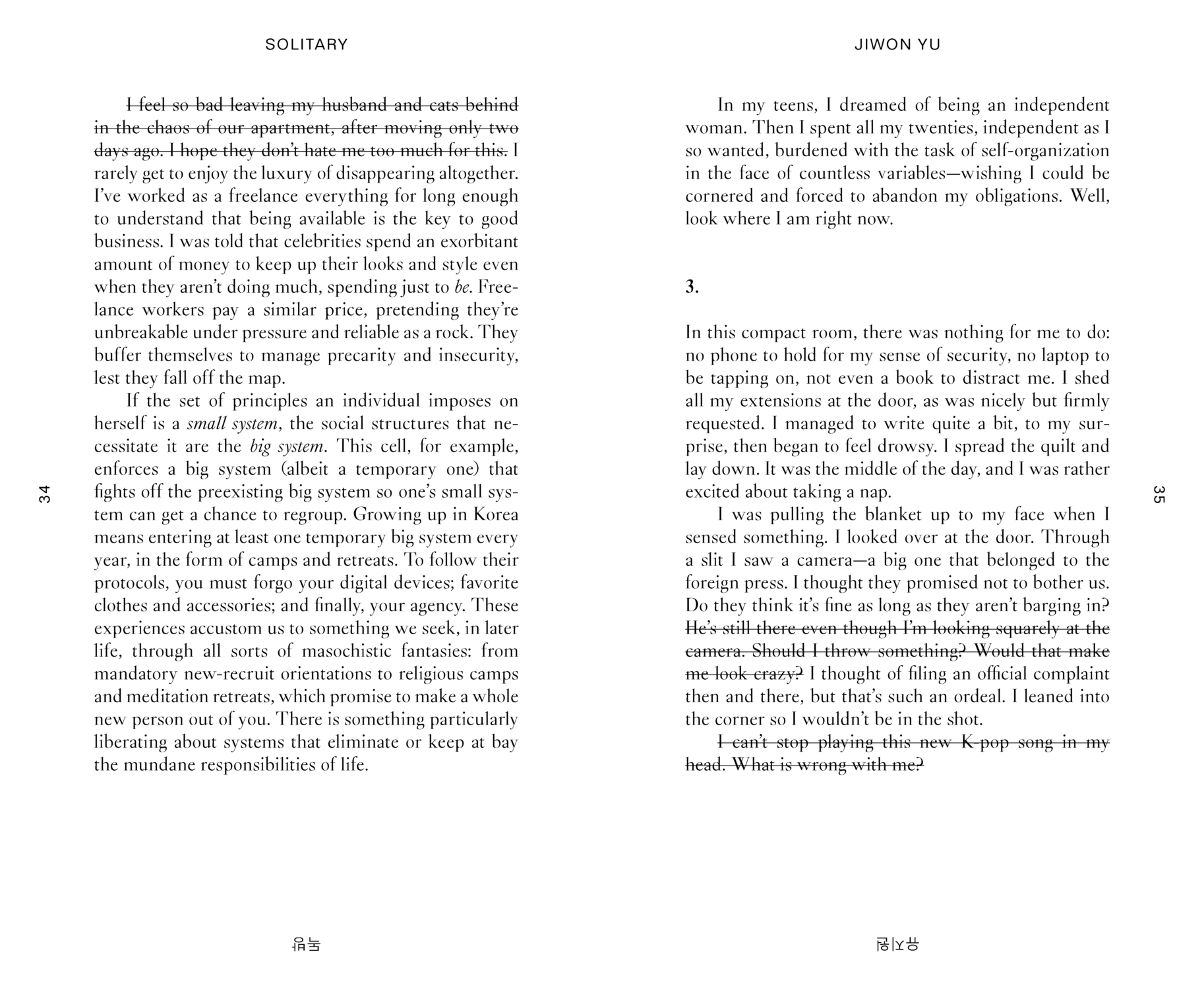
Solitary is a collection of texts written at a wellness center in South Korea designed as a mock prison. This facility is run by an organization called Happitory—a combination of “Happiness” and “Factory.” Happitory offers retreats for teenagers, company employees, government officials, and the general public. Some sessions involve drama therapy, others are led by Buddhist monks. Most intriguing is a program called “Solitary Confinement,” where one can spend twenty-four hours of technology-free time locked in an individual cell.
To create Solitary, artist Tyler Coburn commissioned ten practitioners (including himself) to spend time in solitary confinement at this wellness center, where they produced texts using the materials on hand. Certain questions drove their writing. How does one square the relaxation promised by Happitory with the way solitary confinement functions in actual prisons? What types of thinking and writing become possible through its restrictions—no book, no Internet, just writing materials? How might the emphasis on writing relate to texts by Oscar Wilde, Antonio Gramsci, Kim Dae-jung, Shin Young-bok, and others produced during periods of imprisonment?
EXCERPT
…
일기를 제외하고 평소 글을 쓸 때는 모니터와 키보드, 워드프로세서나 메모장을 사용한다. 인터넷 사전은 필수. 맞춤법이나 각종 표기법을 확인하기도 하고, 가장 먼저 생각해낸 번역어가 최선의 선택일지 판단하기 위해 유의어 사전도 참조한다. 내가 인터넷에 의존하는 것은 철자나 맞춤법에 대한 기본 지식 부족 때문이 아니다. 아니, 그렇게 믿고 싶다. 나는 검색창이 글을 쓰는 내 뇌의 일부분이라고, 그리고 클라우드 저장소는 내 기억의 연장선이라고 생각해 왔다. 이들 없이 글을 쓰면 어딘가 잘못된 느낌이 든다. 마치 내가 나 자신이 아닌 것처럼, 문단은커녕 문장 하나를 구성하는 데에도 고군분투하게 된다.
편집자나 옐로우 펜 클럽[i]의 친구 등 1차 독자와의 상호작용 또한 중요한 요소다. 내가 하는 많은 일 중에서 글쓰기만큼은 ‘내 것’이라고 의식할 때가 있다. 다른 때보다 필자로 참여한 프로젝트에서 좋은 대우를 받는다든지. 하지만 나는 내 글조차 나만의 것이 아니라는 것, 순수하고 투명한 저자성을 주장할 수 없다는 것을 인정할 수밖에 없다. 글을 쓰는 환경, 도구, 사용하는 폰트, 분위기, 참고했던 책과 인터넷의 소스, 그날 있었던 일, 틀어 놓은 사운드, 미리 받은 디렉션, 관련된 사람들의 기대치까지. 글은 결국 그 모든 것들이 함께 추는 춤이다.
…
With the exception of my journal, I usually write with a whole bunch of equipment: a monitor, keyboard, word processor, and more. It’s almost impossible to go without online dictionaries and thesauruses, which make it much easier to toy around with words and find the perfect fit. My reliance on the internet is not due to my lack of basic knowledge of orthography, or so I’d like to believe. I’ve come to consider the search bar a part of my writing brain, and cloud storage an extension of my memory. Writing without them simply feels wrong, as if I’m not quite myself, struggling to form a sentence, let alone structure a paragraph.
My first readers, usually the editor or dear friends of Yellow Pen Club, play an essential role as well. At times I am reminded of how writing, above all other things I do, is what I do. If I’m not mistaken, I tend to be treated a lot better when participating in a project as a writer than in other roles. But I have to admit that I am not the sole master of my writing, and I cannot insist on the pure and transparent authorship of what I produce. The environment, equipment, available fonts, ambience, references, online sources, things that happened during the day, what is playing in the background, directions I received, expectations of those involved: Writing is a collective dance of all these things.
…